Radio Program
The San Juan Backcountry Radio Program (SJBCRP)
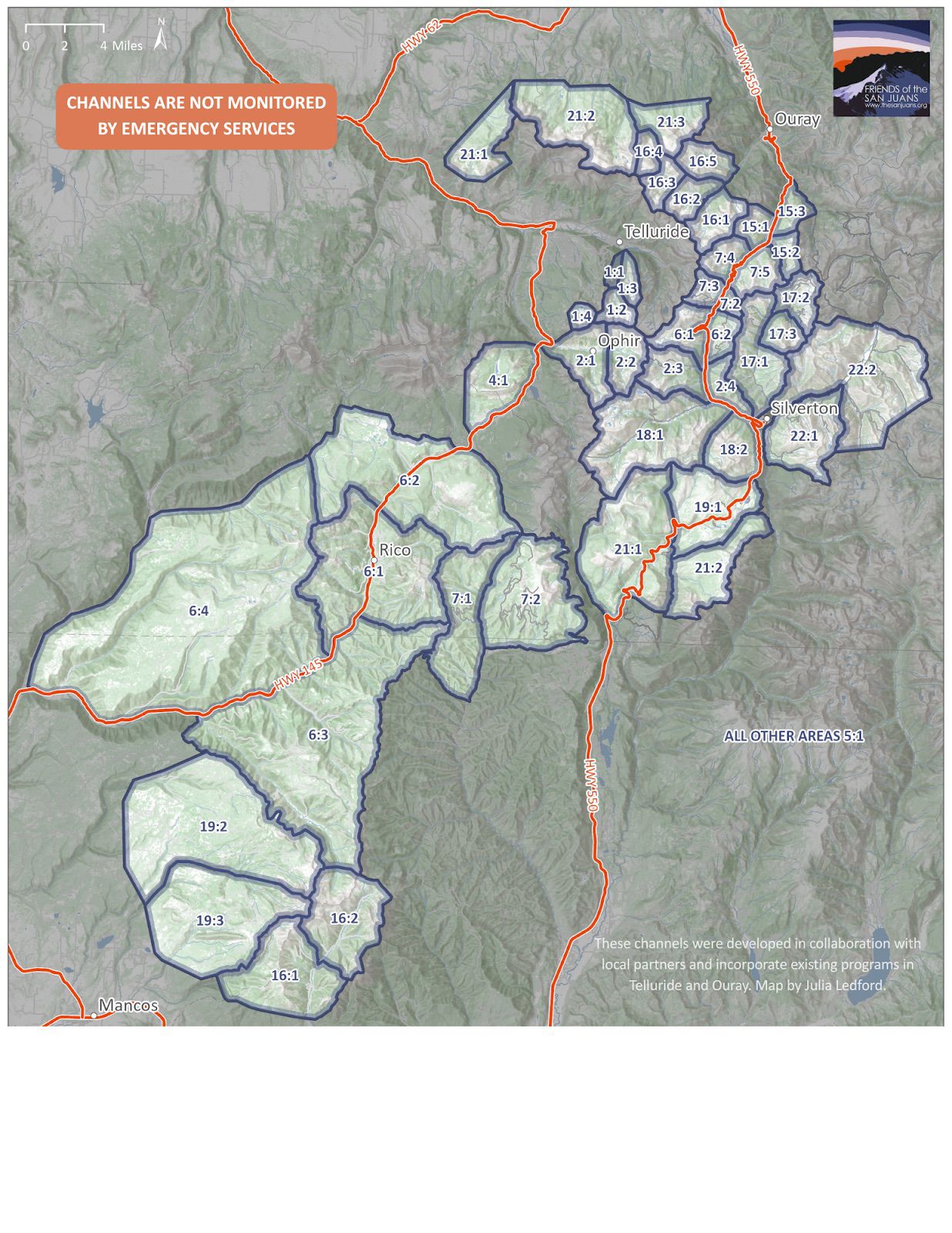
The San Juan Backcountry Radio Program aims to aid in the safety of winter backcountry travelers in the San Juan Mountains by increasing avenues for critical communication within parties, with other parties nearby, and with emergency/rescue services. Backcountry radio programs consist of designated common radio channels assigned to different pieces of higher-trafficked backcountry terrain. These programs allow users in the same zones to coordinate travel, report hazards like changing conditions or recent avalanches, and call for help from other nearby parties in the case of emergency, among other things. The development of this program follows the success of the Telluride Backcountry Radio Program and others throughout the western United States, and the groundwork their contributors have laid has been essential to creating this program.
Please note, transmitting on these channels will only help you communicate to anyone else who is in your vicinity AND also on the same channel. If you are involved in an incident and need a rescue from outside sources, first try calling for help on your radio, THEN call or text 911, THEN try to utilize SOS on a satellite communication device, like a Garmin inReach. You should not rely solely on using your radio to call for a rescue in the backcountry.
Read below to learn how to use the program and access radio program maps!
SJBCRP Intended Uses & Radio Protocols
Radios are critical communication tools in hazardous areas, such as avalanche terrain. We view backcountry radio usage as an important form of risk management for backcountry travelers and, as such, encourage you to use radios for the following purposes:
- To communicate with people within your party.
- To communicate with other parties in your vicinity.
- To announce your “drop in” and find out if other parties are in terrain below you.
- To announce your “all clear” when you are exiting a specific line or piece of terrain.
- To alert your group and other groups about hazards, such as changing conditions or avalanches.
- To send a distress call to your group and other parties to aid in self-rescue.
- To ask for someone to call 911 to mount an organized rescue, when 911 can’t be reached directly on your own.
- For communication between reporting parties and Search and Rescue operations.
The program is most effective when everyone is on the same channel and in the same terrain. With that in mind, we ask that backcountry radio users practice good radio etiquette and strive to minimize unnecessary “chatter” at all costs. Too much chatter means that other users will switch channels, and the program’s benefits will be lost.
Good radio etiquette: be clear, be complete and be concise.
Using radio these radio channels:
- Each major zone is assigned an open channel like 1:0, 2:0, 4:0, etc. To monitor all radio traffic in a major zone, listen to the open channel with no privacy code applied (E.g channel 1:0).
- Each major zone is made up of smaller minor zones that are based on terrain character and usage, which are distinguished with a sub-channel (E.g. channel 1:2).
- To communicate within a minor zone, add the designated sub channel for that area. For example:
- McMillan (7:2)
- Senator Beck (7:3)
- Commodore / Spirit Gulch (7:4)
- Red Mountains (7:5)
- Tuning to the open channel allows you to HEAR all chatter in that area, including transmissions by users who are transmitting with a sub channel applied. If you are on the open channel, you cannot talk to anyone using a sub channel. To communicate to another group, you must be using the same sub channel for them to hear you. For example, if you are on 2:0, you will be able to hear everyone on 2:1, 2:2, 2:3, but they will not be able to hear you.
- In backcountry areas that do not have a designated channel we suggest using the “Other” channel 5:1 to increase the likelihood that you’ll be able to communicate with other groups in the vicinity.
How we recommend using radios on a day in the San Juan backcountry:
- Ensure everyone within your group knows what channel to be on for the area(s) you’re traveling in.
- Complete a “radio check” at the trailhead to ensure that everyone can hear and speak to each other.
- Monitor the designated channel for your area as you’re skinning/approaching your objective.
- Listen for other groups who are on the same channel, they are likely in your vicinity. If deemed necessary, communicate to the other group(s) and let them know you’re in the area and where you plan on traveling.
- Before descending in popular areas, announce your “drop in” to ensure no other groups are below you in the terrain.
- Example: “Party of 3 about to drop into Sam’s Trees, anybody down there?”
- Communicate with your partners on the descent to identify safe re-grouping sites.
- Example: “Jules to Matthew, okay, I pulled out in the trees on the right side of the bench, come meet me here, over”
- Communicate with your partners about potential hazards on the descent.
- Example: “Matthew to Evan, there is a steep convex rollover on the rider’s right side that we should avoid, stay to the left of my track, over”
- In the case of an avalanche, use your radio to alert other members of your group, and other groups in the area.
- Example: “AVALANCHE AVALANCHE AVALANCHE! Keep eyes on them! One person caught and carried in Sam’s Trees! Beginning rescue!”
- If your group needs help from others, use your radio to call for help on the designated channel.
- Example: “We’ve got an avalanche in Sam’s Trees in the Chattanooga Zone, one person is buried, requesting all groups in the area to come help!”
- After descending your line, communicate the “all clear” to other groups in your area before you leave the area.
- Example: “Party of 3, all clear from Sam’s Trees, over.”
Continue to monitor the channel for the area you’re traveling in until you arrive back at the trailhead. You never know when someone out there might need your help and even back at the trailhead, you may be the closest source of help.
Colorado Search and Rescue Channel (COSAR) 3.0
What is COSAR 3.0?
In 2023, the Colorado Search and Rescue Association designated FRS (Family Radio Service) channel 3.0 as the state-wide Search and Rescue Channel, to be used during an emergency for communication between an injured party and a Search and Rescue (SAR) team. Channel 3.0 is not monitored by SAR teams, it is simply a channel on which a backcountry recreationalist, who has already contacted emergency services via 911 or satellite communication device (e.g Garmin Inreach) might be able to communicate with a team once they reach line of sight with the reporting party. To learn more about this effort, read the position paper here: FRS RADIO USE FOR BACKCOUNTRY SAR – POSITION PAPER.
Dual Monitoring Radios
With the increased availability of dual monitoring-capable radios (radios that can monitor transmission on two channels), here are some suggested ways to use the San Juan Backcountry Radio Program (SJBRP):
- If you have a dual monitoring capable radio, don’t use the consensus zone channel for routine communication. Instead, set up your radio to monitor the primary consensus/zone channel as you transmit on another channel to minimize chatter.
- Use these channels only if you are trying to communicate with another group in your vicinity or if you need assistance.
Other Resources:
- Caltopo Training and Information*
- Other Backcountry Radio Programs
- Rocky Talkie user manuals
- BCA Link user manuals
*Please note that there are many great online mapping tools available. We love them all and would be happy to provide you with guidance on how to use them. If you have questions about Caltopo, Gaia, OnX, or any of the other mapping tools, send us an email!
As a member of the San Juan backcountry community, we ask that you take backcountry radio use seriously. Since its inception, the use of this program has prevented incidents and saved lives in our local backcountry, but we need your help for it to continue to be successful. Spread the word about the program to your touring partners and others within our backcountry community, and please use your radio responsibly when traveling in the designated zones. Thank you!
If you have additional questions or feedback about this radio program, please contact info@thesanjuans.org.
Lastly, we’d like to give a huge shout-out to the following contributors for volunteering their time to improve backcountry safety in the San Juan Mountains.